EU data residency for AI: how to enforce it on every LLM call
By Felix Wunderlich -
Published October 12, 2026. Vendor mechanisms and catalogue examples verified at publish time, and we revisit this page as they change.
TL;DR: most AI platforms offer EU data residency as a switch on each call, and a call that forgets it is usually served somewhere else without an error. A policy defines EU once for the whole organization, where the model runs, where the provider keeps content and who owns the provider, and refuses anything outside it before it reaches a provider. On Opper the gateway already runs in Stockholm, an EU route id works per call on any plan, and one model access rule turns your definition of EU into that policy.
Ask an AI assistant how to keep LLM traffic in the EU and it will point you at a switch: an EU base URL, an EU suffix on the model id, a region parameter. This guide covers what "EU" has to mean for a model call, how the major platforms implement it, where per-call switches leak, and how to enforce residency as one policy instead. We build Opper, an AI gateway that runs in Stockholm, and it gets a row in the comparison like everyone else. Every vendor claim links to the vendor's own documentation, checked in October 2026.
What EU data residency has to cover for an AI call
Your prompt reaches a gateway or proxy if you use one, then the provider's endpoint where the model runs, and the provider may keep a copy for logging or abuse monitoring somewhere else. The company running that endpoint also has a legal home of its own. "Keep it in the EU" can mean any of these, and a setting that pins one leaves the others open.
| Question | Why it matters | Rule field on Opper |
|---|---|---|
| Where does the model run? | The prompt is processed there, and it decides whether the call is a transfer under the GDPR | Inference location |
| Where does the provider keep content? | Logs, abuse-monitoring copies and caches can sit in a different country from the GPUs | Storage location |
| Where is the provider's parent company based? | It decides which government can compel the operator, wherever the servers are | Provider country |
The gateway in front counts too, since it processes the same prompt. Which countries count as "EU" is its own question, because the GDPR follows the EEA line and the major clouds draw their "EU region" in different places: our guide to EU vs EEA for AI compliance covers that, and the GDPR-compliant AI guide covers controllers, processors and DPAs.
How AI platforms offer EU data residency today
Most major platforms offer EU residency now, Anthropic's own API being the exception, through a regional hostname, something in the model id or deployment, or a request parameter. Where an organization-wide control exists, it usually lives in a separate tool: the cloud's organization policy or an account guardrail.
| Platform | How you choose the EU | What it covers, per the vendor's docs | Organization-wide control |
|---|---|---|---|
| OpenAI API | A Europe-region project, called through eu.api.openai.com | EEA and Switzerland; data at rest, and inference where the region supports it; some system data and schemas can leave the region; needs approval and a retention amendment | Fixed per project at creation, and each call must use the regional host (docs) |
| Anthropic API | The inference_geo request parameter | us or global only; Claude in the EU runs on Bedrock or Vertex AI | A workspace allow-list of geographies (docs) |
| Amazon Bedrock | The eu. prefix on the inference profile id | EU regions, plus London or Zurich when called from there; abuse-detection copies stored in the region that ran the call | A service control policy can deny global. profiles (docs) |
| Google Vertex AI | The eu or a europe-* endpoint | EU member states only; the global endpoint gives no residency guarantee | An organization policy can block the global endpoint (docs) |
| Azure AI Foundry | A Data Zone EU or regional deployment | The EU Data Boundary, which can include EFTA countries; data at rest in the resource's geography | Azure Policy can block Global deployments (docs) |
| OpenRouter | eu.openrouter.ai, on the Business and Enterprise plans | Prompts and completions processed in the region; a model with no EU endpoint fails | A guardrail rejects other domains with a 403 (docs) |
| Mistral | api.eu.mistral.ai | EU and EFTA data centers; the default endpoint commits to no inference location | Not documented (docs) |
| Opper | An EU route id per call, on any plan; the API itself runs in Stockholm | Inference location, storage location and provider country as separate settings, across every provider in the catalogue | A model access rule per organization or project, on the Control Plane plan (docs) |
Each of these does what its documentation says, and the organization-wide controls are real. The difference is where the policy lives. On a single platform it is a separate tool that enforces the region of an endpoint or deployment, written in that platform's policy language, while the hostnames and prefixes stay in your application code. None of them has the provider's parent company as a setting of its own, and none follows a call to another platform.
Where a per-call EU switch leaks
A per-call switch makes residency a property of every line of code that calls a model. Four places it tends to give way:
- A call site that does not use it. A new service, a script, an evaluation job, a framework whose default base URL is the global one. Unless an organization policy blocks it, that call is served normally somewhere else, and often nothing in the response says so.
- Fallbacks and retries. A fallback list that ends in a model without an EU deployment moves the call outside the region exactly when the primary is down.
- One platform at a time. Each switch covers location on its own platform. A setup with three providers has three switches and three policies to keep in sync.
- Agents choosing models. Coding agents and agent frameworks write code, pick model ids and start sub-calls of their own. A rule that lives with the account holds whatever they generate.
How Opper enforces EU data residency
The gateway hop is already in the EU. The Opper API runs in Stockholm, Sweden, with a second production environment at evroc, the Swedish cloud, and the gateway, traces, usage records and stored files stay there. So there is no separate EU base URL: https://api.opper.ai/v3/compat is the EU endpoint for OpenAI, Anthropic, Gemini and Responses-shaped clients alike, on a platform certified against ISO/IEC 27001:2022.
Per call, on any plan, pick an EU route. Every route in the catalogue records where it runs, and a route's model id pins the call to it: aws/claude-opus-5-5 is Claude Opus 5.5 on AWS Bedrock in the EU. The EU model directory lists every EU route with its provider, country, retention and price, and the catalogue answers the same question without an API key:
curl "https://api.opper.ai/v3/models?type=llm&inference_location=EU&storage_location=EU&limit=0"
On October 12, 2026 that returned 185 of the 966 language-model routes in the catalogue.
As a policy, set one model access rule. On the Control Plane plan, a model access rule defines the part of the catalogue your organization may use. Inference location, storage location and provider country are separate fields, each set to the EU, the EEA or single countries, and a provider data policy can require zero data retention as well. Set for the organization, it applies to every API key and project, a new project starts inside it, and a project override can only narrow it.
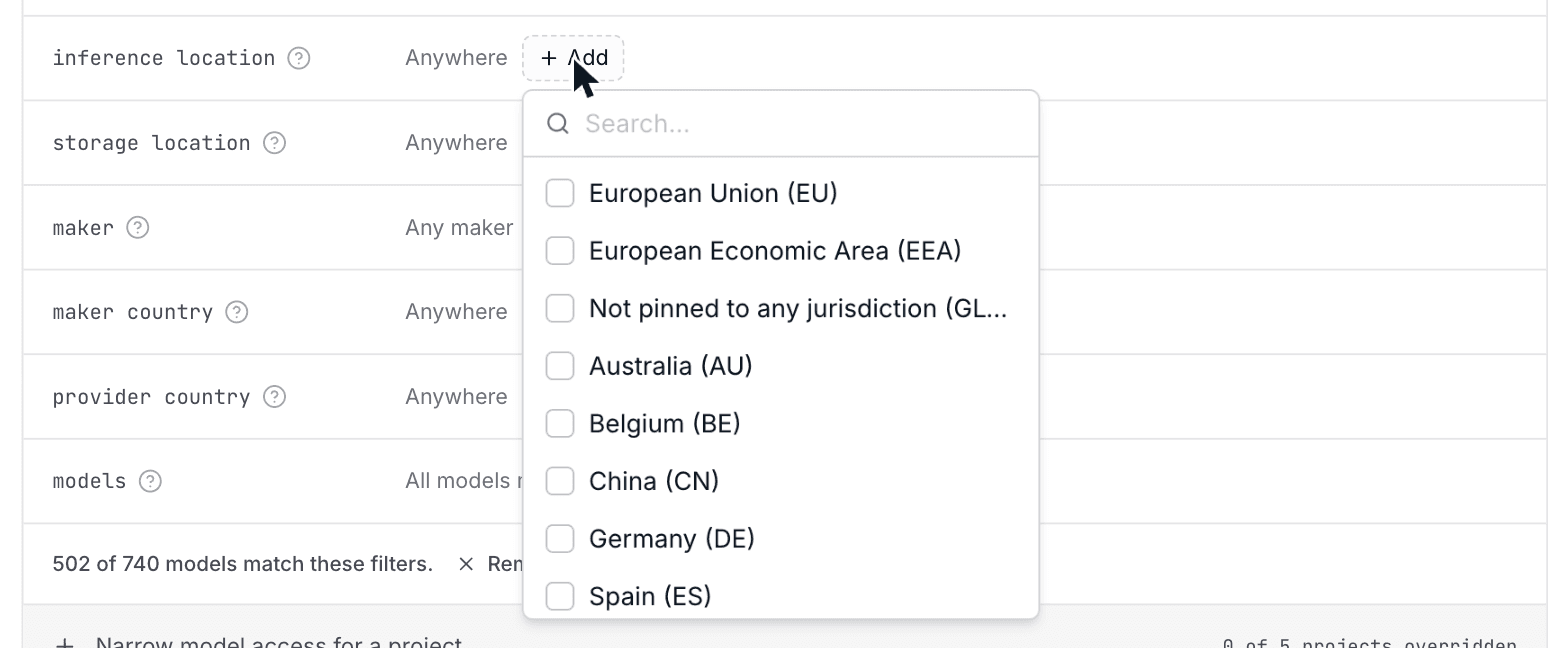
Failover stays inside the rule. A model name without a provider prefix is served by a pool of routes that can span regions. Under a rule with inference and storage location set to the EU, the pool runs only on the routes that pass and skips the rest. These are the routes serving Claude Opus 5.5 on October 12, 2026:
| Route | Inference location | Under an EU inference and storage rule |
|---|---|---|
| aws/claude-opus-5-5 | EU | Used |
| vertexai/claude-opus-5-5-eu | EU | Used |
| anthropic/claude-opus-5-5 | United States | Skipped |
| vertexai/claude-opus-5-5 | Global | Skipped |
| azure/claude-opus-5-5 | Global | Skipped |
Anything else is refused before it leaves Opper. A call pinned to a route outside the rule gets a 403 before anything reaches the provider, whichever key, SDK or app sent it. The message names the model and the condition that failed, and the trace records which rule applied:
{
  "error": {
    "code": "permission_error",
    "message": "model \"anthropic/claude-opus-5-5\" is blocked by the active model allowlist: inference location US is outside EU"
  }
}
Set it from the platform, from code or from your agent. In the platform it is Rules → Model access. The Management API creates the same rule from CI or infrastructure-as-code, with a management key that carries the controls:write scope:
curl -X POST https://api.opper.ai/management/v1/controls/rules \
  -H "Authorization: Bearer $OPPER_MANAGEMENT_API_KEY" \
  -H "Content-Type: application/json" \
  -d '{
    "id": "'$(uuidgen | tr A-Z a-z)'",
    "kind": "comply",
    "enabled": true,
    "scope": {"type": "org"},
    "config": {"type": "allowlist", "allowlist": {"provider": {"locations": {"inference": {"include": ["EU"]}, "storage": {"include": ["EU"]}}}}}
  }'
And a coding agent connected to the Opper MCP server can read and change rules and check whether a model is allowed before calling it, so "keep everything in the EU" is a sentence you can hand to Claude Code or Cursor. The full walkthrough is in the docs under Keep AI inference in the EU.
Write the policy first, then the rule
The rule is only as precise as the sentence it implements, so start from the policy text:
| The policy says | Set on the model access rule |
|---|---|
| Personal data is processed in the EU | Inference location EU, storage location EU |
| Personal data stays inside the GDPR area | Inference and storage location EEA, which adds Norway, Iceland and Liechtenstein |
| Data is processed in one country | Inference and storage location set to that country |
| The provider's parent company is in Europe | Provider country, on top of the location fields |
| The provider does not train on or log content | Provider data policy set to zero data retention |
Most teams need the first or second row: EU hosting on AWS, Azure, Google or a European host, with zero data retention where it matters, is the whole answer for them. The provider-country row is for policies that name jurisdiction rather than location, and for those Opper on evroc runs the gateway on a European-owned cloud with routes to European-owned providers. Projects can carry different rows, so one team can be stricter than the rest of the organization.
How to check that EU residency holds
- Call a route that should be refused. Pin a route outside your definition and expect a
403that names the condition. If it succeeds, the rule is not active for that key's project. - Read which route served a pooled call. The response metadata and the trace name the route that answered, and under the rule it should only ever be one that passes.
- Compare the catalogue with the rule. The same
inference_locationandstorage_locationfilters on/v3/modelsmatch the way the rule does, so you can see what your teams can still use before you save it. - Keep the paperwork aligned. The rule decides which providers can receive your data, so it should match the sub-processors your DPA names. On Opper one DPA covers every model.
EU data residency FAQ
What is EU data residency for AI?+
It is the guarantee that the data in an AI request is processed and kept in the EU. For a model call that means the model runs in the EU, the provider keeps any logs or copies in the EU, and, if your policy asks, the company running the model is based where you require. Vendor EU settings, once you opt in, cover location, inference and usually storage, and leave the provider's parent company to your contracts.
Does EU data residency cover logs and abuse monitoring?+
Only if the setting says so. Several vendors separate where inference runs from where content is stored, so check both. On Opper a route records a storage location where the provider retains content, a route that keeps nothing passes any storage requirement, and a route that keeps content without a recorded location counts as global and fails an EU storage rule.
Is EU data residency the same as data sovereignty?+
No. Residency is where the data is processed and stored, sovereignty is whose law can reach it, which also depends on where the operator's parent company is based. A route can run in Frankfurt and be operated by a company headquartered elsewhere. That is why provider country is its own field on the rule, separate from inference and storage location.
Can a coding agent set up an EU residency rule?+
Yes. Connected to the Opper MCP server, an agent such as Claude Code or Cursor can read and change rules, including a model access rule, and check whether a model is allowed before it calls it. You approve the connection in the browser and choose what the agent may do. Creating rules needs the Control Plane plan.
Define EU once, for every call
A switch answers "where does this call go", a policy answers "where may any call go", and only the second holds up across a growing codebase, a fallback and an agent that writes its own model ids. Define what EU means for you in one model access rule, and check what it allows in the EU model directory before you save it.